After considering the future animation process, I decided to split the character into two parts that will behave differently in the animation. Above is the exterior exoskeleton and on the right, the beginnings of the creature's inner body.Sunday, 15 May 2011
Exoskeleton
After considering the future animation process, I decided to split the character into two parts that will behave differently in the animation. Above is the exterior exoskeleton and on the right, the beginnings of the creature's inner body.Monday, 11 April 2011
Chosen direction...
After discussions with the group about the way in which the growth of the character would be implemented in the game, I have confirmed a direction for the character.
In the meeting we discussed the idea that the character's growth could be shown visually through a morphing animation that would play very slowly throughout the game, triggered and maintained by the constant consumption of in-game stuff.
i.e. from
this,
to
this. (and beyond)
Sunday, 3 April 2011
Sunday, 27 March 2011
Tuesday, 22 March 2011
Final Render Image
An enhanced version of the final render. Blowing out the white in some places gives the image a more atmospheric feeling.
Renders
My final render image. The cavebird is illuminated by torch-like beams and a distant directional glow (from the mouth of the cave).
Getting there..
Some issues I had with smoothing my model, solved below.
Experiment in colour, using seagull as reference. I will pursue a more unique colour and texture palette,
Sunday, 20 March 2011
Wednesday, 16 March 2011
Exploration into foot details.
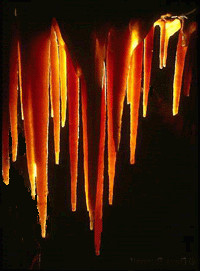
Cavebird's claws gripping stalactites. I'm going to investigate a fusion of cave rock formations and the creature, as the slowly forming stalactites could conceivably secure the creature's feet to the cave ceiling permanently. This would require the animal to live for a long, long time (an average growth rate of a stalactite is 0.13 mm a year) which is possible if the creature has a very slow metabolism. As the cavebird seldom moves, apart from occasionally harvesting its webbed nets, a slow metabolism wouldn't affect its ability to function and survive.
Tuesday, 15 March 2011
Refined Perspective Sketches
I have concentrated more on a skeletal aesthetic, also I have used the feather spines as the reinforcing structure to the webbing that I will apply in Maya.
Interim scan of final creature
This iteration has the creature's claws making up the main structure of its trap. I will investigate the possibility of using both claws and feather spines to form the architecture of the trap.
New musings on my game proposal.
Name (unconfirmed):
ROBOT SPACEFEAST
Concept:
The player pilots a large robotic spaceship that constantly requires fuel in order to continue functioning and sustain the functioning components of the ship. This fuel can take any form, as long as the main mass of the matter being consumed is smaller than the ship’s critical consumable mass (CCM). The CCM is determined by how much matter it has consumed so far and is evident in the diameter of the ship’s gaping furnace.
The more matter the ship processes, the larger the ship gets, the larger the objects the ship can consume, the further the ship goes.
The player will begin by processing small satellites and asteroid belts orbiting planets, eventually moving up to space ships, then space stations until they can consume entire solar systems.
The ship will become visibly larger as the expansion takes place. In a similar way to the katamari game, the camera will gradually move away to enable a full view of the ship.
Sunday, 13 March 2011
Wing Research
A helpful image that I will use to place the devolved spines on the creature's wing structures. Also of interest is the lowest labeled feature, named "Digit II" This is evidence of the evolutionary origins of the wing, as an arm, and is something I will investigate through drawing.
Chosen direction...
After the group critique of concepts, I came away with the most confidence in my cave dwelling bird concept.
I have done some research into the evolution of bird species into the forms they currently hold. One part of this that I intend on incorporating into my creature is a new version of the feather, extrapolated conversely to the current evolutionary direction. According to the infinite knowledge of Wikipedia,
"Feather evolution can be broken down into the following stages:
I have done some research into the evolution of bird species into the forms they currently hold. One part of this that I intend on incorporating into my creature is a new version of the feather, extrapolated conversely to the current evolutionary direction. According to the infinite knowledge of Wikipedia,
"Feather evolution can be broken down into the following stages:
- Single filament
- Multiple filaments joined at their base
- Multiple filaments joined at their base to a central filament
- Multiple filaments along the length of a central filament
- Multiple filaments arising from the edge of a membranous structure
- Pennaceous feather with vane of barbs and barbules and central rachis
- Pennaceous feather with an asymmetrical rachis
- Undifferentiated vane with central rachis"
Thursday, 10 March 2011
Tuesday, 8 March 2011
The Mutortoise
The Mutortoise
This descendant of the tortoise is much more adept in the water than its ancestors, as their former natural habitat above ground has become uninhabitable. The front legs of the creature are mutated in such a way as to provide the animal with a form of propulsion. When put together, the appendages coming off the two front arms can be used as a single tail. The shell has also evolved, protruding out on both sides and the top of the head in order to protect the eyes and face from attack. These protrusions are transparent, so that the creature can still be visually fully aware of its surroundings.
Slightly more refined concepts...
My three most recent and different creature concepts.
The leftmost I've named shovelshrew. His evolution is based around the pursuit of nourishment, as so many are. Based on the anatomy of a bird or small insect eating mammal, the shovelshrew's primary food source is earth worms and grubs. When the creature's hooves are pressed together they create a large scoop (hence it's name) which it uses to quickly unearth its food. The tail is a kind of defense mechanism, but needs revising evolution-wise.
The middle creature is called the king spider and is a cunning cave-mouth dwelling descendant of the birds. With the evolution of glands that produce a hormone irresistible to spiders in the creature's sides and arms, they seduce spiders into taking up residence on their being. The spiders then craft thick but transparent layers of sticky web between the creature's arms. Once the trap is of sufficient strength the king spider eats his hapless helpers and waits for his real prey, bats and birds, to become ensnared in the trap.
Finally the ram is exactly as its name suggests. In the wake of humans, the inhabitable land mass on earth will be predominantly covered with concrete and buildings. The ram preys on small mammals and lizards which, being small in stature, will inhabit the deserted houses and other buildings of the world and become difficult to hunt down. The ram's thick buttress allows it to demolish buildings to feast on the nests within.
The leftmost I've named shovelshrew. His evolution is based around the pursuit of nourishment, as so many are. Based on the anatomy of a bird or small insect eating mammal, the shovelshrew's primary food source is earth worms and grubs. When the creature's hooves are pressed together they create a large scoop (hence it's name) which it uses to quickly unearth its food. The tail is a kind of defense mechanism, but needs revising evolution-wise.
The middle creature is called the king spider and is a cunning cave-mouth dwelling descendant of the birds. With the evolution of glands that produce a hormone irresistible to spiders in the creature's sides and arms, they seduce spiders into taking up residence on their being. The spiders then craft thick but transparent layers of sticky web between the creature's arms. Once the trap is of sufficient strength the king spider eats his hapless helpers and waits for his real prey, bats and birds, to become ensnared in the trap.
Finally the ram is exactly as its name suggests. In the wake of humans, the inhabitable land mass on earth will be predominantly covered with concrete and buildings. The ram preys on small mammals and lizards which, being small in stature, will inhabit the deserted houses and other buildings of the world and become difficult to hunt down. The ram's thick buttress allows it to demolish buildings to feast on the nests within.
Monday, 7 March 2011
Game Proposal Concepts
Game Concept:
Player commandeers a truly massive sentient robot (or city) that requires nourishment in order to function, (consumed matter = energy). This nourishment comes in the form of everything that is smaller than the player's robot i.e. planets. As the player consumes more things, their robot increases in destructive capabilities. Starting with asteroids and satellites, they will move on to entire planets and eventually stars. It's like Feeding Frenzy crossed with Unicron and Katamari Damacy set in space. The player must also defend their vessel against nuclear planetary defenses with carefully timed shield bursts.
Environment Concepts
My concepts centre around an earth after humans, a planet that has to deal with the long lingering effects of our rapid unsustainable technological and population growth. They are based several thousand years after our extinction, allowing ample time for the animal and insect species to evolve and adapt to a human-scarred planet.
Concept 1: Global warming has raised sea levels to unprecedented heights, enveloping vast areas of previously arid land in shallow water. The previously land based animal life must therefore adapt to a life in water, making evolutionary changes in their hunting, breathing, and locomotive techniques in order to survive and thrive.
Concept 2: The vast amount of detritus that already forms massive flotillas in our oceans continues to grow, eventually encroaching upon the majority of the world's surface area. Land animals that rely on the oceans for food must evolve in such a way that they can break through the several feet of waste to reach the ocean's bounty. Equally, sea mammals like whales must break through for air (narwhal-esque).
Concept 3: Once the human population reaches a point where most of the land surface of the planet is covered in urban development, animals inhabiting these spaces must adapt to the artificial environment of concrete and steel. Unsure how this would affect animals, hard feet perhaps?
Concept 4: Due to pollution and deforestation, the amount of breathable air in the atmosphere has been reduced to such a degree that there is only a foot or so of potable air at ground level, the rest being so polluted as to be poisonous. Animals must adapt their physiology to consume less oxygen and to intake it at ground level.
PROJECT 1: Create a Creature
First post, here goes...
Subscribe to:
Posts (Atom)